How to Properly Mix Dry Yeast for Dough: Step-by-Step Guide + Video

Baker's yeast is a favorite among those who love to treat their loved ones to airy, delicate baked goods. It makes dough fluffier, more airy, and melt-in-your-mouth delicious. Dry yeast is one of two types of yeast used in cooking. It's easy and convenient to work with, making it the most common type.
There are active, granulated, and instant dry yeast. Unlike the latter two, the first type of dry yeast must be diluted to be fully utilized. I'll explain how to dilute dry yeast and prepare a dough starter correctly.
How to dilute dry yeast
- Proteins: 12.7 g
- Fats: 2.7 g
- Carbohydrates: 2.5 g
- Total time:
-
Complexity:
It will work even if you're making it for the first time. Not just this dish, but your first time ever.
- Number of servings: 1
Ingredients
-
Milk500 ml
-
Dry yeast20 G
-
Powdered sugar1 tbsp
-
Flour100 G
Preparation

Heat the milk to 36 degrees Celsius. The milk temperature shouldn't be too low or too high for the dry yeast. Using cold milk won't allow fermentation to start, and using hot milk will cook the yeast bacteria. Pour into a container.

Add dry yeast and stir. Be sure to check the expiration date of the yeast, otherwise the dough may not rise or will turn out too dense.

Add the powdered sugar. Stir. Be careful at this stage and remember! Salt is usually added to the dough, not the starter. Salt actively inhibits the activation and reproduction of yeast, slowing down the fermentation process. Powdered sugar can be substituted with sugar.

Add sifted flour to the yeast mixture and mix thoroughly.

Place the dough in a warm place. You can cover the container with a kitchen towel or cling film. Let it rest for 1 hour until bubbles form on the surface. The dough starter is ready!
Video recipe - Making the dough: how to properly activate dry yeast?
You can find plenty of videos on YouTube from food bloggers, home cooks, and amateurs on how to make a basic sponge. But I recommend checking out the videos on the ChocoYamma channel.
In it, pastry chef Yuri Volkov explains how to make the perfect starter for yeast dough. It can be used to bake yeast buns or filled pies, soft breads and sweet pies, and also to prepare the base for homemade pizza and focaccia. Products made from it are soft as feathers, airy, and fluffy.
The video clearly and thoroughly demonstrates the step-by-step process of making the dough. This recipe always produces a good dough. The video is short, so it won't take much time, but it will be very useful for future baking.
Rules for working with dry yeast
There are two main types of yeast used in cooking: pressed and dry. They each have their own advantages and disadvantages.
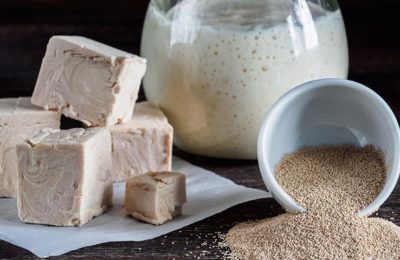
Compressed yeast This is a ready-to-use active product that works immediately upon adding to dough. It is sold in blocks of 50, 100, and 500 g. High-quality pressed yeast has a uniform color, is not yellow, and is free of spots or mold. It has a loose, non-sticky texture. It can be stored for one month in the refrigerator. A major advantage of pressed yeast is that it can be frozen. It is best to cut the block into small pieces of 25–50 g. This is done because defrosted pressed yeast cannot be placed in the freezer repeatedly. Otherwise, it will lose its properties and quality. To divide a large block, use a string, stretching it taut and running it lengthwise.
Dry yeast Dry yeast is dehydrated pressed yeast in powder form. It is sold in small portions of 10–20 g per packet. The average shelf life of dry yeast is up to 18 months. After opening, store in the refrigerator in a tightly sealed container and use within 7 days. A distinction is made between regular and instant dry yeast. While instant dry yeast is mixed with flour during the baking process, instant dry yeast requires activation.
Pressed and dry yeast are interchangeable and are used in a 1:3 ratio. For example, 30 g of pressed yeast = 10 g of dry yeast. In addition to its traditional use in baking, yeast is also used in the production of kvass, beer, and even sparkling wine.
To quickly react dry yeast, also add 1 teaspoon of sugar to 10 g and rub with your hands until body temperature. It is best dry yeast is suitable in milk — the dough turns out more tender and airy.