How to dilute raw (live) yeast for dough

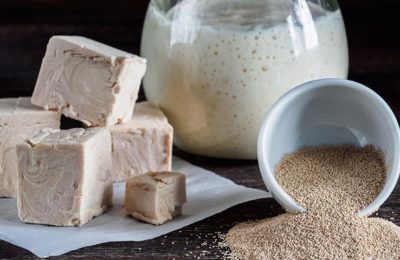
Live yeast (pressed, fresh, wet, or in briquettes) is actually living fungi that have been removed from the production process, compressed, and wrapped in paper or foil. Live yeast has a milder flavor than dry yeast and perfectly enhances the sweetness of baked goods. It is often used for baking bread, vatrushki (cheesecakes), kulich (Easter cakes), and croissants—that is, doughs that require long or repeated proofing.
How to dilute raw yeast
- Proteins: 12.7 g
- Fats: 2.7 g
- Carbohydrates: 0 g
- Total time:
-
Complexity:
It will work even if you're making it for the first time. Not just this dish, but your first time ever.
- Number of servings: 1
Ingredients
-
Milk100 ml
-
Sugar1 tbsp
-
Live yeast25 G
-
Flour3 tbsp
Preparation

Pour warm milk into a deep container. Its temperature should be approximately 37-40 degrees Celsius. If you don't have a thermometer handy, test the milk with your finger: it should be neither cold nor hot.

Add sugar to the milk. You don't need to add much sugar to the starter. It's needed to "feed" and activate the yeast. If you're making sweet baked goods, most of the sugar will be added to the dough separately, at a later stage.

Color the yeast. Keep in mind that 1 kg of flour typically requires 35 to 50 g of fresh yeast, depending on the type of dough (sweet dough requires more). If you don't have fresh yeast, you can substitute dry yeast. You'll need about a third as much dry yeast—in our case, about 8 g.

Add the flour and mix well. Don't worry about breaking up all the lumps; they'll disperse naturally as the mixture steeps.

After adding all the ingredients, the dough should have the consistency of liquid sour cream.

Cover the container with a towel and leave it in a warm place for 20-30 minutes. Some housewives cover the dough with cling film. In this case, it's best to cover the container loosely or poke small holes in it with a toothpick. This will allow better air circulation and allow the dough to rise properly.

If no bubbles appear on the dough at all, you can't use it for baking. Most likely, the yeast is stale and not working. Replace the yeast and try again.
Video - Compressed yeast: how to use it for dough?
If you're unsure about activating pressed yeast correctly, be sure to watch this video. The author clearly and thoroughly demonstrates the entire yeast activation process, highlighting important points to ensure the best results.
After watching this video, you'll have no more questions, and you'll be able to make your own dough with ease and confidence, without fear of failure. Incidentally, in addition to the mixing process, the recipe also shows the final result. This is what your dough should look like if the compressed yeast has worked.
7 Secrets of Working with Live Yeast
Some housewives are afraid of yeast dough. And they shouldn't be. There's nothing complicated about it, especially if you know the rules and secrets of working with live yeast.
- Yeast must be fresh. Check the expiration date. Do not use expired product.
- Failure to properly store the product will negatively impact its potency. Therefore, before you begin cooking, test the yeast for potency.
- Pressed yeast can be frozen. So if you've got a good batch, you can safely stock up and store it in the freezer.
- To prepare the dough, use warm milk or water, between 37-40 degrees Celsius (98-104 degrees Fahrenheit). A low liquid temperature will prevent the yeast from activating.
- Avoid overheating the dough when preparing the dough. The yeast will die in an unfavorable environment.
- Follow the recipe exactly. Using more yeast than recommended can result in an unpleasant odor in your baked goods. If you don't use enough yeast, your baked goods may not rise. For every 1 kg of flour, use at least 35 g of yeast for standard baking and 50 g for rich baked goods.
To activate yeast, you can to use not only sugar, but also any other sweetener: sugar substitute, licorice syrup, natural honey.