"Macedonian" dessert made from fruits and berries

Content
Macedoine is a French word that literally translates as “Macedonian”. This is what the French called anything colorful and unusual. These descriptions perfectly describe the appearance of this stunning dessert, which combines fruits and berries of a wide variety of colors.
There are hundreds of macedoine recipes. A wide variety of fruits and berries are used, but one condition must be strictly observed: all ingredients must be in season. This dessert Macedoine is divided into summer, winter, and autumn varieties. In southern countries, there is also a spring version. For example, in the Transcaucasian countries, a spring version of this dessert can be made with cherry plum, mountain blackberry, and sweet cherry. In Russia, autumn or winter macedoine is made with apples, peaches, pears, apricots, and oranges. Summer macedoine is made with pears, wild strawberries, strawberries, cherries, and currants.
The origin of the dessert
Macedoine first appeared in France in the 17th and 18th centuries and was served exclusively in wealthy and noble families. Initially, it was a dish in which fruits and berries were soaked in aromatic syrups containing liqueur or wine, topped with ice cream. Some of the ingredients were gelled using natural substances, such as isinglass or pigskin glue. The resulting jelly was delicate yet quite strong.
Vanilla, cinnamon, and cloves were added to the maceduane. All the fruits and berries were alternated and layered in a tall pan. The pan was then refrigerated, and once the dessert had set, it was removed. The finished dish was cut into pieces or spooned onto a plate. The appearance of maceduane on the holiday table was always unexpected.
This dessert appeared in Russia in the second half of the 19th century. There's a whole story behind it. One summer day in 1844, a dinner was scheduled at Monplaisir, one of the palaces in Peterhof. According to the menu served to the empress, dessert was supposed to be ice cream with cream. However, it turned out that at that very moment, a whole basket of magnificent fruits—the most varied and juiciest—had been delivered to the imperial court from private greenhouses. Emperor Nicholas Pavlovich immediately ordered the maitre d', Amber, to prepare something unusual with the fruit. The dessert was such a success that all the guests were absolutely delighted. The new dish was immediately dubbed "Monplaisir Macedoine."
Unlimited imagination allows you to prepare this dish with absolutely any ingredients. Nowadays, you can find maceduane made not only with berries and fruits, but even with meat and vegetables: cabbage, potatoes, carrots, pork, beef, and chicken.
Macedoine is a truly aristocratic dessert, easily accessible to every homemaker. Let's try making a true summer macedoine using an old recipe.
Secrets of a proper macedoine
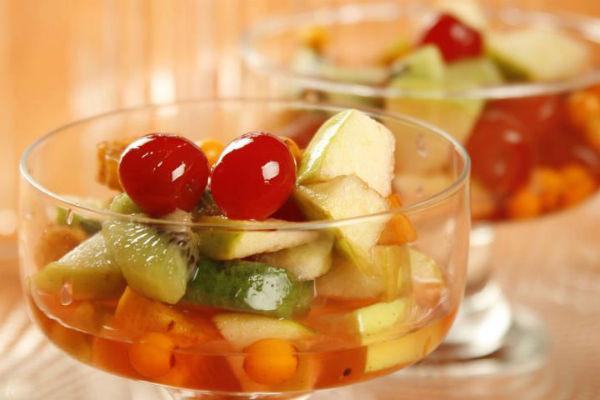
To ensure this magnificent dessert turns out beautiful, you need to follow a few rules:
- Fruits and berries - only one season;
- It is better if all ingredients are fresh and not frozen;
- Berries and fruits must be peeled, pitted, and cut into equal-sized cubes. The smallest ingredient determines the size—if it's raspberries, the remaining pieces should be the same size as the berries.
- All dense fruits are slightly simmered in sugar syrup for 10-15 minutes, tender berries and juicy grapes remain fresh.
We create beauty
This amazing dessert is easy to prepare, but it does take a while – 2-3 hours. To make it, you'll need:
for the salad:
- 1 melon (about 2.5 kilograms);
- 1 peach;
- 3 apricots;
- 150 grams of strawberries;
- 150 grams of cherries;
- 100 grams of raspberries;
- 1 tablespoon of gelatin;
- 150 ml of water.
for the syrup:
- 100 ml of water;
- 1.5 – 2 glasses of champagne;
- 2 tablespoons lemon juice;
- 1 cup of sugar.
Cooking steps

- Let's start with the melon. Carefully trim the bottom for stability and cut off the lid on top. The melon should resemble a vase or goblet;
- Using a spoon, remove the net and seeds from the melon;
- Also, carefully scoop out the pulp with a spoon. It's best to leave the bottom thicker;
- Cut the melon flesh into small cubes. Use cherries or raspberries as a guide in size;
- Cut the peach crosswise, scald it with boiling water, carefully remove the skin and also cut it into cubes;
- We cut the apricots. You don't need to peel them, as the skin is already quite thin;
- Cut the cherries in half and remove the pits;
- Finely chop the strawberries. Don't forget to save a couple of berries for garnish;
- Place all prepared fruits and berries in the refrigerator;
- Pour a tablespoon of gelatin into water and let it swell. Then dissolve the gelatin in a double boiler or microwave. Watch carefully—the gelatin should never boil.
- Now you need to make the syrup. To do this, add sugar to water, optionally adding a little melon juice. Cook, stirring, until the sugar is completely dissolved. Then let the syrup cool;
- Pour gelatin, champagne and lemon juice into the cooled syrup;
- Place the melon in a deep bowl and carefully transfer the already mixed fruits and berries into it. Pour the gelled champagne over everything and refrigerate until set – at least 2-3 hours.
- Remove the dessert from the refrigerator and garnish with strawberries. You can serve it directly in the melon, or portion it out onto pretty plates.
Macedoine can be made for children, too, but in this case, be sure to replace the champagne with juice. Beautiful, bright, and aromatic, it's sure to be the centerpiece of any table! Enjoy!