Medovik Soak – Top 5 Recipes + Video
Medovik has long been associated with Soviet classics. But this is a dessert that was originally created for the Russian Emperor Alexander I. An unknown pastry chef made it so that he would be Very soft, gentle and juicy. Impregnation for honey cakes will help you achieve the same result.

Content
- 1 Sugar impregnation
- 2 Sugar syrup for soaking the sponge cake
- 3 Video: 3 Cake Soak Options
- 4 Orange impregnation
- 5 Orange impregnation for sponge cake
- 6 Condensed milk impregnation
- 7 Impregnation for sponge cake made from condensed milk
- 8 Lemon impregnation
- 9 Lemon Soak for Sponge Cake
- 10 Creamy impregnation
- 11 Creamy impregnation for sponge cake
- 12 Flavor combinations with honey
The classic recipe doesn't use syrup to soak the Medovik cake layers. They're already quite moist thanks to the butter. Adding extra liquid will only make the dough soggy and less flavorful.
However, there are now many recipes that omit eggs, butter, and other ingredients. Such Medovik cake bases can be quite dry. In this case, you should use a soaking agent to prevent the cream layer from completely soaking into the dough.
Sugar impregnation
Sugar syrup for soaking the sponge cake
- Proteins: 0.1 g
- Fats: 0 g
- Carbohydrates: 31.9 g
- Total time:
- Time in the kitchen:
-
Complexity:
It will work even if you're making it for the first time. Not just this dish, but your first time ever.
- Number of servings: 1
Ingredients
-
Sugar600 G
-
Water250 ml
-
Lemon (slice)1 pcs
-
Citric acid0.25 tsp
Preparation

Place the sugar in a saucepan and add water. Immediately add a lemon wedge.

Place on the stove and turn on medium heat. Start stirring until the sugar is completely dissolved.

Stop stirring and bring the syrup to a boil. At this point, add the citric acid and quickly stir until completely dissolved. Cook for 1 minute and remove from heat.

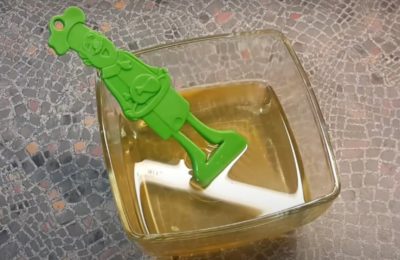
Pour the syrup into a glass container that can withstand high temperatures.

The sugar syrup for the cake is ready. Remove the lemon wedge and let it cool to room temperature before using.
Video: 3 Cake Soak Options
This video features versatile impregnation recipes. As a professional pastry chef, Polina demonstrates the entire preparation process and offers tips on how to use them.
The mint and berry infusions that the author primarily demonstrates are hardly a standard solution. For making a classic honey cake at home, the last milk syrup recipe is best.
Orange impregnation
Orange impregnation for sponge cake
- Proteins: 0 g
- Fats: 0 g
- Carbohydrates: 34.1 g
- Total time:
- Time in the kitchen:
-
Complexity:
It will work even if you're making it for the first time. Not just this dish, but your first time ever.
- Number of servings: 1
Ingredients
-
Orange juice150 ml
-
Sugar (or powdered sugar)150 G
-
Water100 ml
-
Cinnamon1 pcs
Preparation

Peel the oranges, being careful not to touch the white part between the peel and the pulp. This is where the bitter part is, which can make the infusion taste less than ideal. Then cut the oranges in half.

Juice the citrus fruits using a regular hand juicer. If the slits are too wide and orange seeds fall into the juice bowl, strain the juice through a sieve.

Place the orange zest in a saucepan. Add sugar, a cinnamon stick, and half the water. Adjust the amount of water depending on how thick you want the sauce to be. If necessary, add the remaining water halfway through the cooking time.

Bring to a boil and cook until the sugar is completely dissolved, stirring with a spoon. This will take 2 minutes.

Now add the orange juice and the remaining half of the water. Bring to a boil and simmer for 7 minutes over medium-low heat.

Strain the mixture, removing the zest and cinnamon using a slotted spoon. Or, to speed up the process, pour everything into a bowl through a fine-mesh sieve.

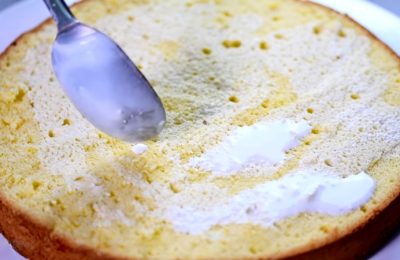
Prick the hot sponge cake with the tines of a fork and spread the impregnation evenly over the surface.
Condensed milk impregnation
Impregnation for sponge cake made from condensed milk
- Proteins: 2.1 g
- Fats: 7.8 g
- Carbohydrates: 23.1 g
- Total time:
- Time in the kitchen:
-
Complexity:
It will work even if you're making it for the first time. Not just this dish, but your first time ever.
- Number of servings: 1
Ingredients
-
Condensed milk380 G
-
Water (boiling water)200 ml
-
Cognac15 ml
Preparation

Measure out the required amounts of ingredients. Bring the water to a boil on the stove or in an electric kettle. This will help soften the taste of the alcohol and make it easier for the condensed milk to dissolve.

Combine cognac with water.

Stir quickly to distribute evenly.

Pour hot water into a bowl with condensed milk.

Mix until a homogeneous mixture is obtained.

The condensed milk soak is ready. Use it for a cake 24-26 cm in diameter. Or pour it into a jar, seal it with an airtight lid, and refrigerate until ready to use. Stir again before use to ensure the soak is uniform.
Lemon impregnation
Lemon Soak for Sponge Cake
- Proteins: 0.2 g
- Fats: 0.1 g
- Carbohydrates: 18.1 g
- Total time:
- Time in the kitchen:
-
Complexity:
It will work even if you're making it for the first time. Not just this dish, but your first time ever.
- Number of servings: 1
Ingredients
-
Sugar (or powdered sugar)100 G
-
Water300 ml
-
Lemon1 pcs
Preparation

Combine the water and sugar and bring to a gentle simmer. Stir and cook until the sugar is completely dissolved. To speed up the process and prevent caramelization at the bottom, stir everything with a spoon. Then simmer the syrup over medium heat for 15 minutes, maintaining a simmer.

Grate the zest using a fine-hole grater. Then cut the citrus in half and squeeze the juice from each half. Remove any seeds that may have fallen into the bowl.

Combine the reduced syrup with the lemon juice and zest. Stir gently with a spoon or spatula. Cook for 1-2 minutes over low heat, maintaining a simmer.

Let the syrup steep for 3-5 minutes. Then strain through a sieve to remove the zest.

The lemon infusion is ready. Use it according to the planned recipe only after it has cooled completely. To speed up the cooling process, pour it into a glass container.
Creamy impregnation
Creamy impregnation for sponge cake
- Proteins: 0.2 g
- Fats: 0.1 g
- Carbohydrates: 17.4 g
- Total time:
- Time in the kitchen:
-
Complexity:
It will work even if you're making it for the first time. Not just this dish, but your first time ever.
- Number of servings: 1
Ingredients
-
Cream 10%100 ml
-
Powdered sugar2 tbsp
Preparation

Pour 10% cream or any other alternative you like into a bowl.

Add powdered sugar and flavoring, mixing well until evenly distributed and lump-free. It's best not to use sugar, as it will take a long time to dissolve.

The creamy impregnation is ready. Use it to moisten white and chocolate sponge cakes or desserts.
Flavor combinations with honey
I won't dwell on classic combinations like honey with cinnamon, ginger, vanilla, or the aforementioned lemon. As you experiment with Medovik flavor combinations, you can try more exotic variations:
- lime;
- cranberry;
- apple;
- mango;
- black currant;
- dark chocolate;
- hazelnut or peanut butter, praline.
These ingredients can be added to the cream filling or used for cake decoration. In the latter case, you can decorate individual pieces of the dessert with different toppings according to the classic recipe, and then choose the ones you like best.
For a more uniform dough texture, liquid honey is considered ideal. If it has crystallized, you can melt the solid lumps in a double boiler. For the perfect flavor, it's best to choose aromatic varieties, with the exception of buckwheat and acacia. Despite their excellent flavor, the cakes will taste slightly bitter after baking.
3 questions about impregnations