

How to make almond flour at home
Continuing the theme of healthy eating, today we'll talk about how to make delicious and healthy almond flour at home, which is used in a variety of dishes.

- Proteins: 25.8 g
- Fats: 54.5 g
- Carbohydrates: 13.0 g
- Total time:
- Time in the kitchen:
-
Complexity:
It's easy and straightforward to prepare, but it does require some experience. Not everyone can do it right the first time.
- Number of servings: 1
Homemade almond flour is perfect for making:
- festive cake;
- popular macaroons;
- almond cookies;
- any PP desserts.
The basis of this flour is only natural roasted (or well-dried) almonds, so it retains all the beneficial properties of this product.
However, thanks to its beneficial properties, almond flour is an indispensable element of healthy eating and keto diets.
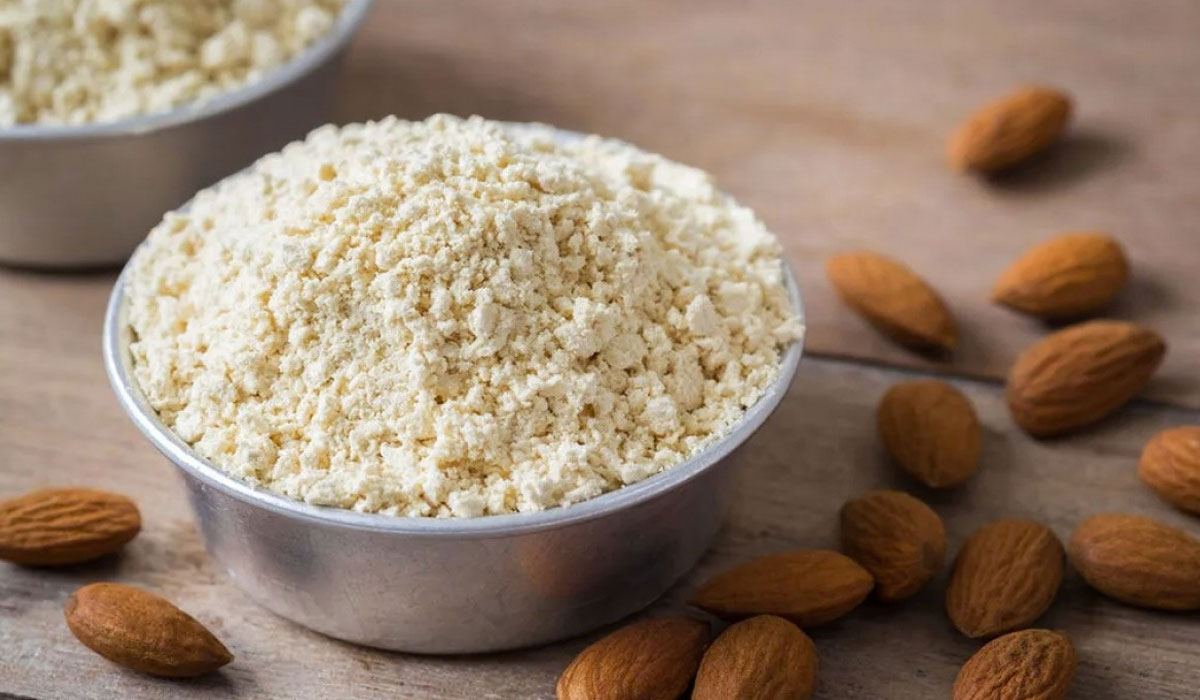
The price of almond flour in Russian stores ranges from 1,000 to 3,000 rubles per kilogram, while ground almonds, which are easy to grind at home, are much cheaper.
It is especially important to know how to make the finest almond flour at home for those who plan to cook French macarons, because if you simply grind almonds in a coffee grinder set for coffee beans or grind them with an immersion blender, the grain size will be too coarse. It's impossible to get the right macronage from such flour, which means you won't get a delicious classic macaron, no matter how hard you try. Keep in mind that industrially prepared flour has a grain size 40 microns, which is almost impossible to achieve at home.

Using a household coffee grinder to grind almonds is not recommended. These devices get very hot, causing the almonds to release oil and creating an irregular flour texture. Essentially, what's created is not a dry powder, but an almond paste. This is fine if you plan to mix the ground almonds with honey, but it's definitely not suitable for making macarons.
-
Almond120 G

First, you need to peel the almonds. To do this, add the almonds to boiling water and let them simmer for 1 minute.

Remove the nuts with a slotted spoon and spread them out on a board to cool. You can also pat the nuts dry with a paper towel to remove excess moisture from the surface.

Separate the nut kernels from the skins. After scalding with boiling water, this is very easy to do, as the skins will peel off on their own with gentle pressure from your fingers.

Peeled almonds can be dried again with a paper towel before transferring to a baking sheet.

The next step is the actual grinding of the almonds.
Although the recipes for making almond flour at home are very similar, not everyone succeeds at making almond flour. The quality of the grind depends on many factors:
- chopper power;
- sharpness of knives;
- the location of the cutting elements (they should be located as close as possible to the bottom of the bowl).

If your blender doesn't have this feature, simply turn the blender on for 5-7 seconds, pausing briefly between grinds. Pausing is crucial. If you overdo it, the almonds will release their oils, and you'll end up with a paste rather than flour, just like with a home coffee grinder.

Sift the first batch of ground almonds through a sieve.

The procedure can be repeated several times, sifting the small fraction and additionally blending the large pieces remaining in the sieve.
If you want to make almond milk in addition to flour, try the second recipe in this video. It's not as simple or quick as the one described previously, but the flour is white, less fatty, and extremely finely grained.
- 15 min
- 48 kcal
- 1934
- 20 min
- 210.15 kcal
- 3097
- 15 min
- 34 kcal
- 3183

- 20 min
- 0 kcal
- 776
- 15 min
- 52 kcal
- 1303
- 30 min
- 0 kcal
- 425
- 20 min
- 46 kcal
- 598
- 45 min
- 57 kcal
- 1382