

Korean braided donuts
If you're looking for a unique donut recipe, try these Korean twisted donuts with the amusing name "Kkwabaegi" for a change. And yes, that's not a typo; the word begins with two "K"s. They stand out from traditional desserts with their twisted knots, and they look very cute.

- Proteins: 6.4 g
- Fats: 22.8 g
- Carbohydrates: 43.1 g
- Total time:
- Time in the kitchen:
-
Complexity:
It's easy and straightforward to prepare, but it does require some experience. Not everyone can do it right the first time.
- Number of servings: 6
Braided donuts They are widely distributed in South Korea, where they are sold in bakeries and street vendors. These treats are considered to be at their most delicious immediately after cooking, because they are air inside and crispy outside.
The doughnuts are prepared without filling, but coated with cinnamon sugar. This makes them very tasty, especially if served the same day. If kwabaegs sit for a while, they won't be as flavorful. They'll become denser inside, and the crust won't be as crispy.
-
Milk250 ml
-
Sugar2 tbsp
-
Dry yeast7 G
-
Butter30 G
-
Egg C11 pcs
-
Flour430 G
-
Salt3 G
-
Sunflower oil300 G
-
Sugar2 tbsp
-
Cinnamon1 tsp
-
Vanilla sugar10 G

Pour warm milk into a bowl and add sugar, then stir until completely dissolved.

Add the yeast, mix well, and let sit for 10 minutes to allow the yeast to form bubbles on the surface of the milk. Then add the eggs and melted butter and whisk until smooth.

Gradually add the flour through a sieve and knead until the dough is smooth, soft, and uniform. Finally, add the salt and continue kneading for another 3-5 minutes.

Grease a bowl with sunflower oil, place the dough ball in it, and cover with plastic wrap. This will prevent it from drying out and forming a crust. Let it rise for 1 hour in a warm place.

Transfer the dough to a work surface and divide it into 12-16 pieces using an offset spatula. Press the pieces down and form them into balls. Cover them with plastic wrap to prevent them from drying out.

Roll each piece into a sausage about 1-1.5 cm thick and 30 cm long. Then twist one end to the right and the other to the left to create a beautiful pattern.

Grab the dough by the ends and lift it up. The sausage will twist itself into a double braid. Pinch the ends together and place them on a work surface. Repeat with the remaining pieces of dough.

Cover the doughnuts with cut-up bags or cling film. Leave them to rise until ready to fry.

Heat sunflower oil in a frying pan or saucepan over medium-low heat. To check for doneness, insert a toothpick into the center; if bubbles form around it, it's ready to fry. Drop the donuts into the pan and fry until golden brown on all four sides.

When done, place the donuts on paper towels to drain off excess grease and keep the dough crisp. Then, mix the sugar, cinnamon, and vanilla in a small bag, place the donuts in it, seal, and shake from the bottom up. This will ensure the topping is evenly distributed.

The twisted Korean doughnuts, or kkwabegi, are ready. Place them on a serving platter and serve as a dessert.
The dough will be slightly sticky. Use a small amount of flour if necessary to prevent the dough from sticking to the work surface and tearing. If you can manage without it, it's best to skip the flour altogether. This will make the donuts too dense, rather than light and airy.
Kkuabegs are very filling. So don't make too many donuts, even for a large family. A couple will be enough for even an adult.
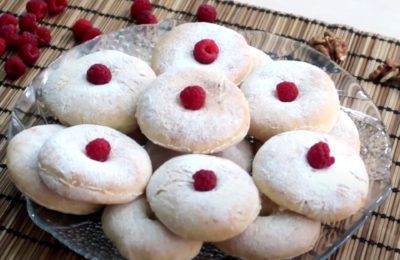
- 45 min
- 201.1 kcal
- 2526
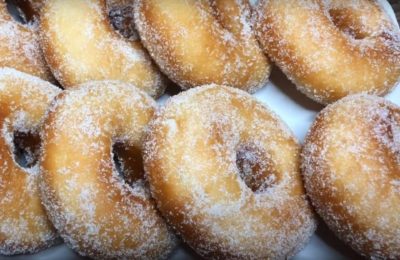
- 1 hour 50 minutes
- 328.7 kcal
- 5364
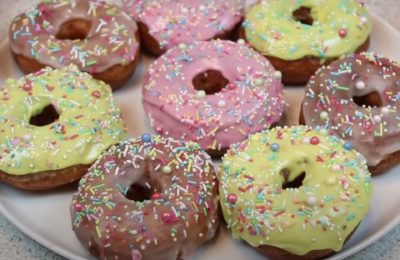
- 4 hours 10 minutes
- 296 kcal
- 5350
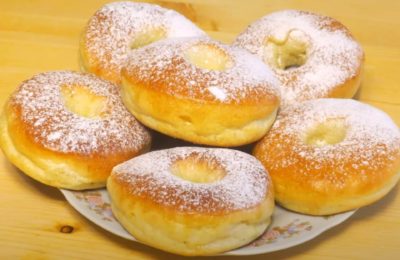
- 2 hours
- 331.4 kcal
- 3862
- 30 min
- 500 kcal
- 892
- 4 hours 30 minutes
- 331.4 kcal
- 1304
- 2 hours 30 minutes
- 257 kcal
- 7619
- 30 min
- 331 kcal
- 2765