

Meringue roll with banana
What could be more delicate than meringue, you ask? Only a banana meringue roll, I'd say. This delicious dessert, made with simple ingredients and requiring no culinary skill, can be made by almost anyone. It's a joy to make, let alone eat.

- Proteins: 3.5 g
- Fats: 7.8 g
- Carbohydrates: 39.2 g
- Total time:
-
Complexity:
It's easy and straightforward to prepare, but it does require some experience. Not everyone can do it right the first time.
- Number of servings: 1
The crisp meringue layer, filled with airy and sweet banana cream, literally melts on the tongue. No one can resist this mouth-watering roll.
-
Egg whites200 G
-
Powdered sugar200 G
-
Cornstarch25 G
-
Hazelnut40 G
-
Banana1 pcs
-
Sugar35 G
-
Cream 33%150 G
-
Butter10 G
-
Mascarpone250 G

Pour the egg whites into a stand mixer bowl or a deep metal bowl if using a hand mixer. The bowl should be clean and grease-free to ensure the egg whites whip well.

Start beating at low speed, then increase the speed for approximately 13-15 minutes. When the whites form a fluffy white foam, gradually add the powdered sugar, continuing to beat the meringue. You can also use regular sugar, but powdered sugar will give the mixture a denser, velvety texture.

Add cornstarch to stabilize the mixture. Gently mix with a spatula or mixer at low speed.

The mixture should be thick and stand upright. Be careful not to overbeat the meringue.

Place the meringue on parchment paper or a silicone mat and smooth it out into a thick, even layer. Sprinkle with ground hazelnuts for flavor, if desired. You can substitute any other nut for the hazelnuts.

Bake the meringue in the oven for 15-20 minutes at 180 degrees Celsius. Preheat the oven to ensure the cake is thoroughly dried inside.

Once the meringue is set, let it cool. To do this, flip it over onto another sheet of parchment paper and transfer it to a wire rack. Avoid placing the cake in a draft to prevent the meringue from falling!

Pour a quarter of the cream sugar into a frying pan and melt over medium heat.

Add butter to the liquid sugar caramel. Stir. Cook the mixture over low heat until smooth.

Cut ripe bananas into cubes and add them to the caramel. Stir. Cook until smooth.

Sprinkle the mascarpone with half of the remaining cream sugar and beat with a mixer until fluffy. Soft cottage cheese or cream cheese can be used as an alternative to mascarpone.

Pour the cream into a blender, add the remaining sugar. Beat with a mixer. Combine with the mascarpone. Mix.

Spread a thin layer of butter cream on the cooled meringue cake.

Then we spread the banana-caramel filling.

Roll the roll up, using parchment paper to help you. Try to wrap it as tightly as possible. Refrigerate the dessert to soak and set.

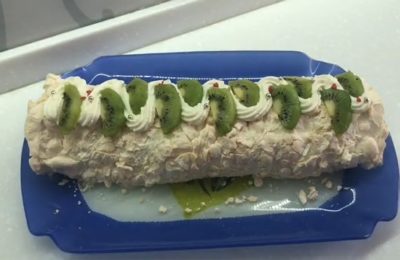
Decorate the roll. You can decorate the dessert with pieces. kiwi. It will turn out not only beautiful, but also very fresh. Done.
Types of meringue
Meringue is whipped egg whites mixed with sugar. It's widely used in cooking as a standalone dish and as a garnish for other desserts. Pastry chefs differentiate between meringues:
- Swiss;
- French;
- Italian.
They differ in their preparation technology.
French meringue — the simplest type of meringue. Its recipe is particularly popular among home cooks. To make it, beat raw egg whites with sugar in a 1:2 ratio. To achieve a beautiful, dense, and fluffy French meringue, add sugar to the whipped egg whites. Bake the cake for 1.5-2 hours at 100 degrees Celsius.
Italian meringue It's most often used as a cream or decoration for cakes and desserts. In this case, the whipped mixture is lightly browned with a blowtorch. Italian meringue is made with sugar syrup, which helps the mixture hold its shape for a long time. According to the recipe, add the cooled syrup to the egg whites, whipped until they form white peaks. Then beat the mixture until it forms white peaks.
Swiss meringue — a classic version of meringue. It was in picturesque Switzerland that this beloved dessert was first created. It's prepared in the same proportions as the French version. But its distinctive feature is the egg whites, heated in a double boiler. Sugar or powdered sugar is added, and then whipped to the desired consistency.
Italian, French or Swiss: Which Meringue is Better?
Whichever meringue you choose, all three types have a virtually identical taste and texture. They make excellent substitutes for each other in dishes.
But if we talk about stability and security, then the following nuances can be highlighted:
- French meringue collapses easily, so starch is often added. It's not safe to eat raw, as the whites are uncooked.
- Swiss meringue has a relatively stable density and is safe to use uncooked.
- Italian meringue is considered the safest and holds its shape well.
Which meringue to use for desserts depends entirely on your taste. Do you have a favorite meringue?
- 40 min
- 398.5 kcal
- 1192
- 40 min
- 281.8 kcal
- 1783
- 3 hours
- 362 kcal
- 1762
- 4 hours 20 minutes
- 81 kcal
- 291
- 30 min
- 394 kcal
- 484
- 2 hours 10 minutes
- 44.4 kcal
- 1283
- 5 hours
- 251 kcal
- 2052
- 1 hour
- 219 kcal
- 5527