Anna Pavlova – a dessert in honor of the ballerina

Content
What did this woman do to deserve to remain with us forever in a dessert with a divine and light taste? Sweet, strange, tender Anna.
We know nothing about the true life of the famous ballerina of the 1920s. Even Anna Pavlova's biography is devoted solely to the art and secrets of virtuoso dance. The second book about this beautiful and sensitive creature was written from the words of her husband, Victor Dandre. Overwhelmed by despair and melancholy after the loss of his beloved, the meaning of his life, he could only sketch out their happy journey together.
Anna lived so full of her work and was so consumed by her muse that she saw no point in talking about her love affairs and domestic problems. Meanwhile, Australia and New Zealand watched her career grow. Her star soared to the heavens and shone with all her facets so brightly that standing ovations and millions of flowers at her feet were a small part of what her fans could offer their idol in gratitude for the time they spent watching her perform.
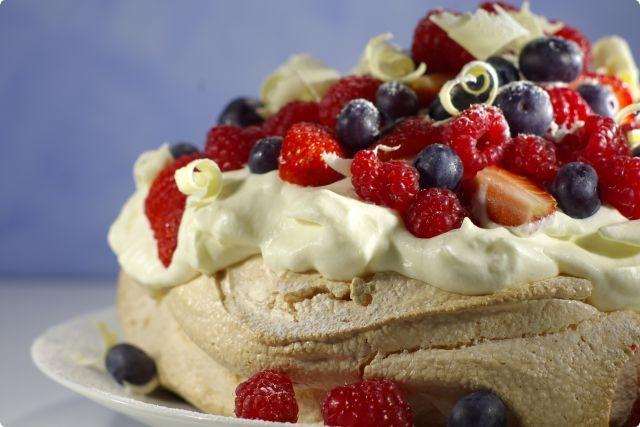
The controversy surrounding the creation of a dessert for a ballerina continues to this day. In New Zealand, they believe the recipe originated with the chef at the hotel restaurant where Pavlova spent her free time during her 1926 tour. Meanwhile, Australians claim the dessert appeared on their Esplanade Hotel menu in 1935 with the help of renowned chef Bert Sachet. After tasting the cake, the chef himself couldn't contain his admiration, exclaiming, "Oh, how airy it is! Just like Pavlova herself!" And since this particular cake was made for the ballerina's birthday, it didn't need a name.
New Zealand or Australia?
Interestingly, today we cannot pinpoint the authentic recipe for the Anna Pavlova cake. Professor Helen Leach has compiled a magnificent collection of recipes derived from the original under the same name. The book contains 667 of them. The desserts were compiled from three hundred original cookbooks. The professor titled the collection "Pavlova: A Piece of New Zealand Culinary History."
Meringue is the basis of all cake and dessert recipes. It symbolizes the ballerina's white dress. It is decorated with snow-white buttercream and pieces of fresh tropical fruit. The dessert appears as a baked, solid mass on the outside, but the secret to the recipe resides within. The delicate, airy, and incredibly delicious secret of true meringue lies beneath the crust, hidden within this pastry chef's creation.
Baking the classic Anna Pavlova cake takes a lot of time and effort, but it's worth it. If you overheat the oven or underheat the meringue, the dessert will be hopelessly ruined. Everything must be done precisely to the last second of baking. And then your dessert will be as beautiful as the photo.
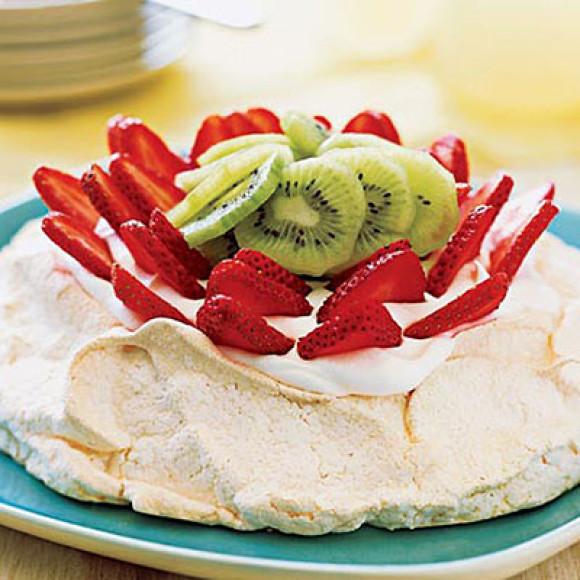
If the cake releases sweet drops while baking, the oven is too hot. If you take the dessert out of the oven and notice it's starting to "cry," it didn't have enough heat and time to cook fully. This recipe might not work the first time, but don't worry. Pavlova is a fickle dessert.
From the very first step of preparation, pay attention to your dish.
While you're creating, turn on your favorite music, lift your spirits, sing, dance around the kitchen, and prepare the dessert with love. This will help you create your masterpiece, forever known as "Anna Pavlova."
Dessert recipe:
To prepare this truly amazing Anna Pavlova cake, you will need the following ingredients:
- Chicken eggs 4 pcs.
- Sugar 225 g
- Vinegar 1 tsp
- Vanilla sugar, vanillin 1 tsp
- Starch 1 tbsp.
Let's start cooking:
To begin, the recipe requires separating the egg white from the yolk, ensuring not a single drop of yolk ends up in the white mixture. Otherwise, the dough won't be suitable for making this dessert. Remember: one mistake and all your work will likely go to waste.
While your oven is preheating to 180°C (350°F), whisk the egg whites until they form stiff peaks. If you have a mixer, use one. This is allowed in the recipe. Once the egg whites have thickened, add the sugar gradually and mix it into the foam. If you add all the sugar at once, the foam will stop forming and the mixture will not be fluffy.
Prepare a separate, clean, dry bowl. Combine the vanilla and cornstarch, add 1 teaspoon of vinegar, and mix thoroughly. Carefully pour the mixture into the egg whites, continuing to whisk. Whisk until the mixture becomes glossy and very thick.
It's not recommended to spread the dessert mixture on a bare baking sheet. Use parchment paper instead. Imagine an even circle on the baking sheet or draw one on the parchment with a pencil. When spreading the mixture evenly into the drawn circle, make sure to leave a 2-centimeter margin around the edges, as shown in the photo.
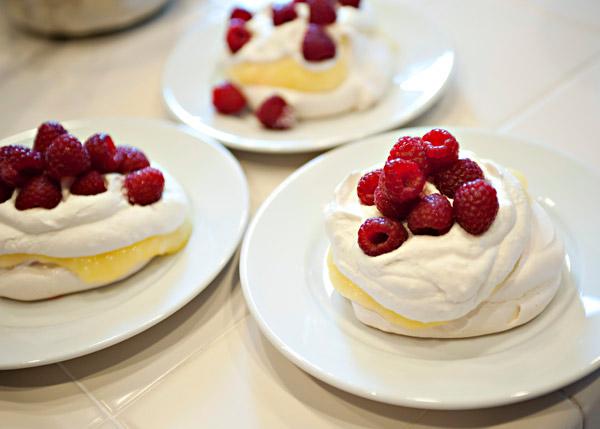
Place the resulting mold in a preheated oven and immediately reduce the heat to 100°C (212°F). The dessert recipe will bake for exactly 60 minutes.
Don't remove the meringue immediately. If it comes into contact with cold air, it will deform and deflate. Let the pan cool in the oven.
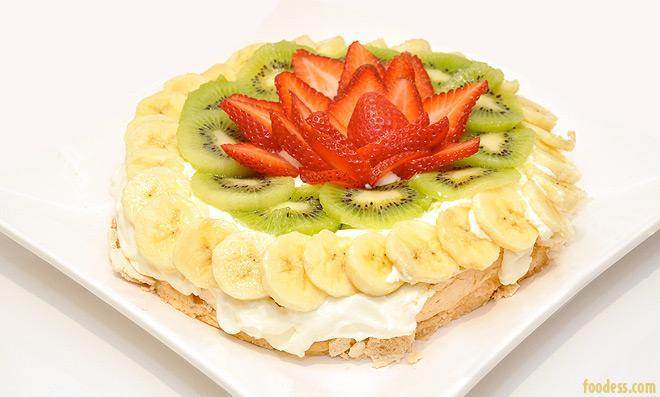
Once the cake has cooled and retained its shape, you can remove it from the oven, place it on a beautiful cake stand, and garnish with whipped cream and pre-prepared fresh fruit pieces. For those who prefer a more savory and original recipe, add passion fruit or feijoa.
Wishes for decoration:
Try to decorate the cake just before serving, as fruit juices can soak through the hard but fragile crust and ruin the appearance.
This recipe makes 8 servings, which can be shared if desired. The cake's lightness and low calorie content—the meringue—will keep you from getting full and from turning away from the plate, even for a moment. The baked goods are undeniably tender, crispy, sweet, and unobtrusive.
Interesting Facts About the Desserts Pavzilla and Palokong
The love for "Annushka" is steeped in history, tracing back to various eras. For example, just recently, 15 years ago, New Zealand's national museum, Te Papa Tongarewa, in Wellington, New Zealand, created a massive pavlova cake, 45 meters long, based on a historical recipe, for its birthday (see photo). Due to its enormous size, Annushka was renamed "Pavzilla" to denote its scale and grandeur. New Zealand Minister Jenny Shipley was honored to share this dessert among the guests and the heroes of the occasion.
But the years go by, and the eternally youthful ballerina's popularity continues to grow, captivating audiences with her refinement time and again. This is confirmed by an incident that occurred in 2005 in New Zealand, a country that adores the confectionary masterpiece "Anna Pavlova." A huge sweet cake, "Pavlokong," became a jewel of the Eastern Institute of Technology, thanks to its students. To create such a monumental dessert, a whopping 5,000 egg whites were required, along with 100 kilos of sugar and the same number of liters of pure cream. The dessert recipe was also adhered to in this case.
Thus, the magnificence of the last century's ballerina, the incomparable Pavlova, remains among us, in memories, photos, and the story behind the creation of a dessert beloved in every corner of the planet. And even those who are completely uninterested in art and have no idea who we're talking about will surely, after trying this dessert, inquire about the biography of the person who so captivated the hearts of the people that she never died.
And here is a visual aid - a video clip about preparing the dessert.